Jason Davis • December 6, 2019
The Downlink: ExoMars Rover Testing, Bennu's Mysterious Particle Ejections
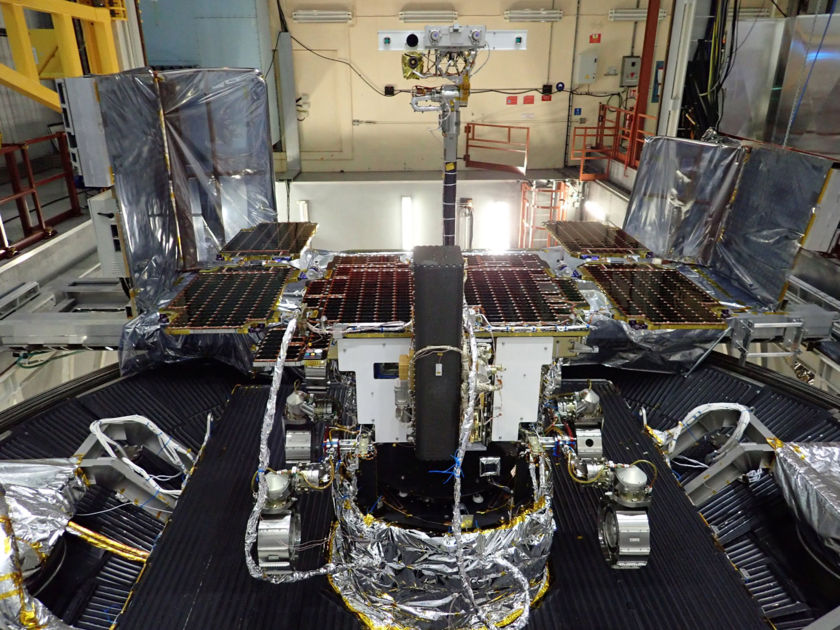
Airbus
ExoMars Thermal Vacuum Testing
The European Space Agency’s ExoMars rover Rosalind Franklin undergoes thermal vacuum testing in Toulouse, France ahead of launch.
Welcome to issue 10 of The Downlink, a planetary exploration news roundup from The Planetary Society! Here's everything that crossed our radar this week.
 The European Space Agency’s ExoMars rover Rosalind Franklin, which is scheduled to launch in July or August next year, is undergoing thermal vacuum testing in Toulouse, France. The rover will be heated and cooled to simulate the environmental conditions of its journey through space and on the Martian surface. Learn about the four missions headed to Mars next year.
 The team behind NASA’s OSIRIS-REx mission released a new paper describing how asteroid Bennu may be periodically ejecting small particles from its surface. Scientists cite three explanations: meteoroid impacts, thermal stress fracturing, and the release of water vapor (or some combination of all three). Learn more about the OSIRIS-REx mission here.
 Citizen scientist Shanmuga Subramanian found scars on the lunar surface left by the crash of India’s Vikram spacecraft, using imagery from NASA’s Lunar Reconnaissance Orbiter spacecraft. Vikram lost contact with Earth during its landing attempt on 6 September 2019. The images show a new crater and debris field, confirming an uncontrolled crash. Learn more about the Chandrayaan-2 mission here.
 The European Space Agency’s CHEOPS exoplanet-studying spacecraft received its supply of hydrazine fuel that it will use for in-space maneuvering. CHEOPS is scheduled to launch on 17 December.
 Astronauts aboard the International Space Station completed the third spacewalk to repair the Alpha Magnetic Spectrometer, a cosmic-ray detector that helps astrophysicists search for dark matter. During the spacewalk, Luca Parmitano and Andrew Morgan successfully installed a new cooling system. Learn more about the International Space Station here.
A SpaceX Dragon cargo ship launched to the International Space Station carrying almost 2.6 metric tons of cargo and science equipment. Dragon will arrive on Sunday, 8 December, at which point European Space Agency astronaut Luca Parmitano will grapple the spacecraft with the station’s robotic arm.
Scientists have proposed a way for the James Webb Space Telescope, which is scheduled to launch in 2021, to determine whether certain rocky exoplanets have atmospheres. The technique involves measuring the planet’s temperature as it passes behind its star.
 After departing asteroid Ryugu using conventional thrusters in mid-November, Japan’s Hayabusa2 spacecraft is heading back to Earth using its long-duration ion engines. The spacecraft is carrying two samples from Ryugu’s surface. “People of Earth, we have just shipped a delivery from Ryugu. The delivery will arrive in about a year,” said the project manager. Learn more about the Hayabusa2 mission here.
China’s Chang’e-4 lander and Yutu-2 rover completed their 12th day of operations on the far side of the Moon. The rover has driven more than 345 meters since landing in January. Learn more about the Chang’e-4 mission here.
We heard you: Thanks for your feedback requesting an email version of The Downlink! You will find it in our redesigned Planetary Society newsletter in early 2020. Be among the first to receive it by subscribing to our email list today!
Read more: asteroid 162173 Ryugu, Hayabusa2, OSIRIS-REx, Chang'e 4, extrasolar planets, James Webb Space Telescope, The Downlink, CHEOPS, Chandrayaan-2, ExoMars 2020, the Moon, International Space Station, Mars, asteroid 101955 Bennu
Related Articles
Abigail Fraeman
Javier Gómez-Elvira
Jason Davis

Let's Change the World
Become a member of The Planetary Society and together we will create the future of space exploration.
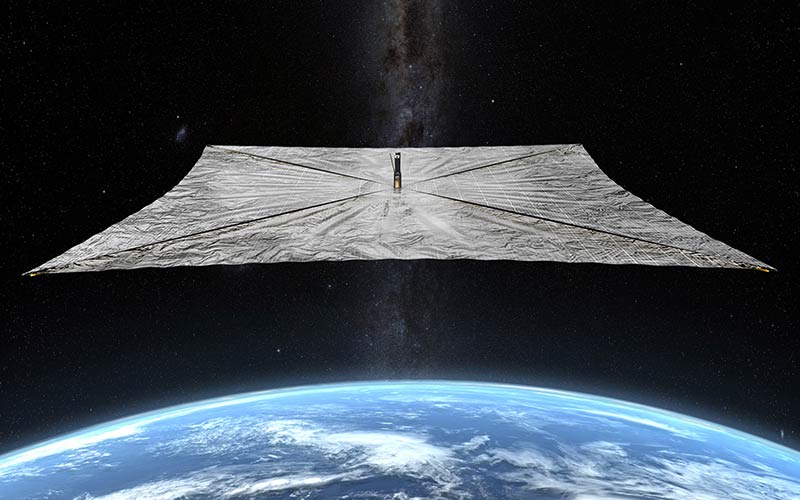
LightSail 2
LightSail 2 launched aboard the SpaceX Falcon Heavy. Be part of this epic point in space exploration history!
from Planetary Society Blog https://ift.tt/38aXDTj
via IFTTT

沒有留言:
張貼留言